Commit Optimization for Large MySQL Transactions
This article is also available in Chinese: 中文版. Browse all English articles.
If you use and operate MySQL, you’ve surely run into a strange slow query like this:
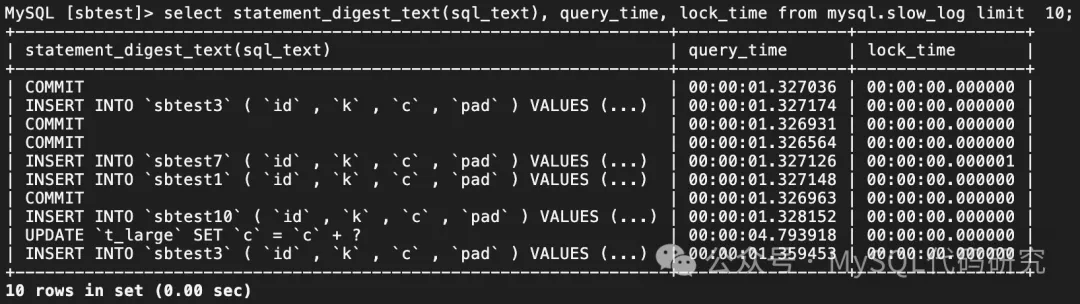
- An
INSERTthat’s normally instant took1.3s, and the slow-query log shows no long lock wait. - Every statement in a multi-statement transaction had already finished, yet the
COMMITalone took1.3s.
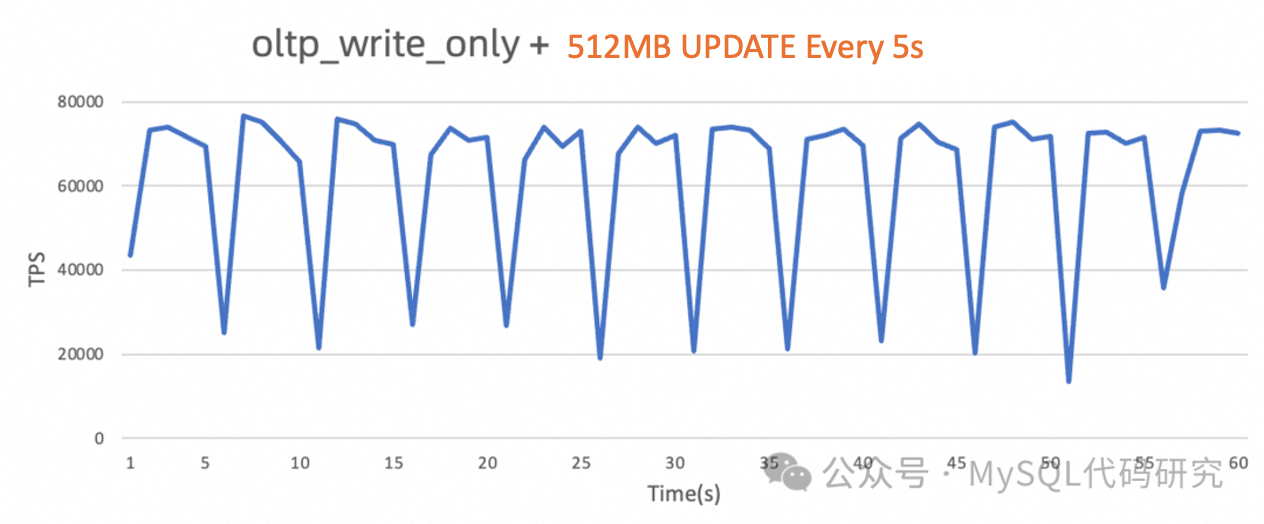
When this happens, the most likely cause is a large transaction committing. Below is a simulated test: we used sysbench to simulate a normal workload, then ran a large UPDATE in the background every 5 seconds. You can see the large UPDATE severely hurts performance.
Root Cause
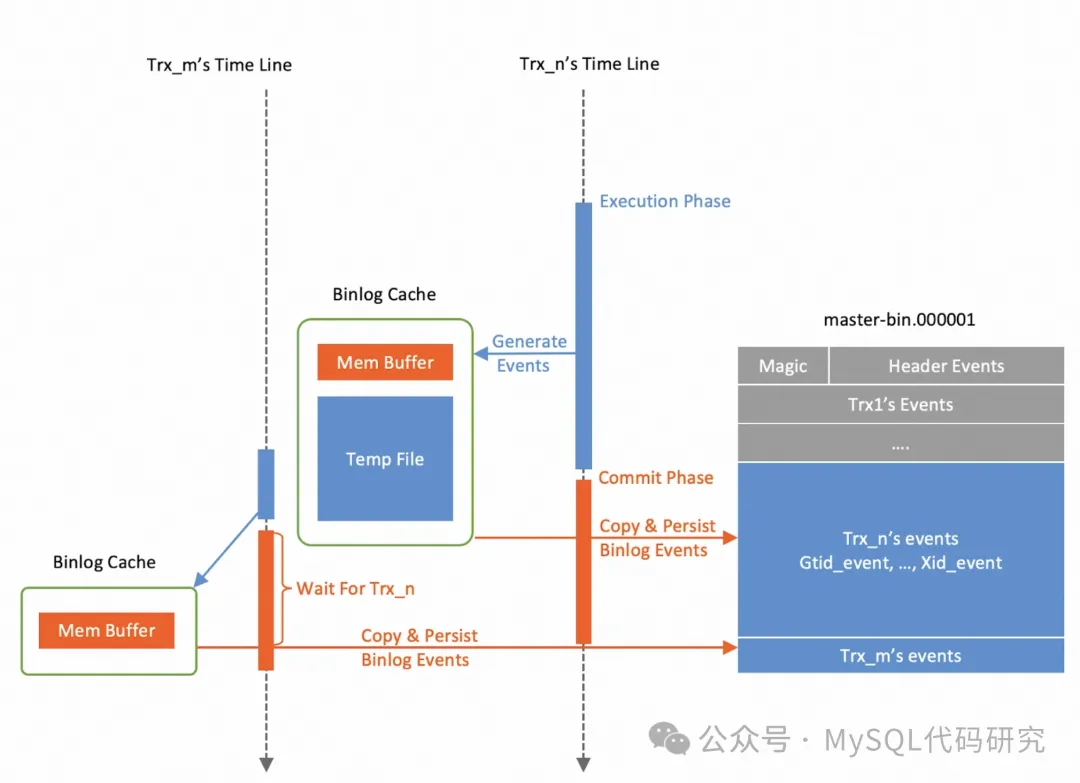
The figure above shows the execution of two transactions:
- A transaction runs in two phases: an execution phase and a commit phase.
- During execution, when a statement updates data it generates binlog events. These are stored in the Binlog Cache, which has two parts: an in-memory buffer and a temporary file. When the buffer fills up, the events are written to the temporary file.
- At commit, all the binlog events in the Binlog Cache are copied into the binlog file.
- Writing binlog events to the binlog file must be serialized — one transaction can’t do it until the previous one has finished. So while
Trx_nis writing to the binlog file,Trx_mhas to wait. - In the figure,
Trx_nis a large transaction that produced a lot of binlog events. The time to copy binlog events into the binlog file is linear in the size of the events the transaction produced — the more events, the longer the copy takes. Trx_mis a small transaction. Even though its execution phase finished quickly, at commit it runs into the large transactionTrx_ncommitting, so it must wait forTrx_nto finish copying its binlog events before it can proceed.Trx_mspends most of its commit phase waiting forTrx_nto write the binlog file — and that’s why the small transaction becomes slow.
How Serious the Problem Is
As our simulated test shows, committing a large transaction has a major impact on workload stability. In real-world scenarios it can be far worse, and it’s common.
- A GB-scale transaction can make the instance unwritable for a long time. Since storage IO bandwidth is fixed, the time to write a large transaction’s binlog depends on the transaction’s size. The largest transaction we’ve seen in production produced
104 GBof binlog events. - A GB-scale transaction can push IO throughput up and slow it down, or even saturate IO, which also slows queries.
- A few-hundred-MB transaction won’t cause a long outage, but it can still add hundreds of milliseconds to application DML. For latency-sensitive workloads, even that may be unacceptable.
- On top of this, all of the above can raise the number of active connections. If those active connections aren’t cleared in time, CPU spikes, and it can turn into a vicious cycle — eventually an avalanche and a much bigger problem.
Optimizing How Large Transactions Write the Binlog
In AliSQL we optimized how a large transaction writes the binlog, completely eliminating the stability impact of large-transaction commit. RDS 5.7 and RDS 8.0 both enable this optimization by default. Last year we contributed it to MariaDB, and the feature shipped in MariaDB 11.71.
The Approach
Here is the implementation in MariaDB 11.7. MySQL and MariaDB have diverged quite a bit in code, but the underlying logic — and therefore the approach — is the same.
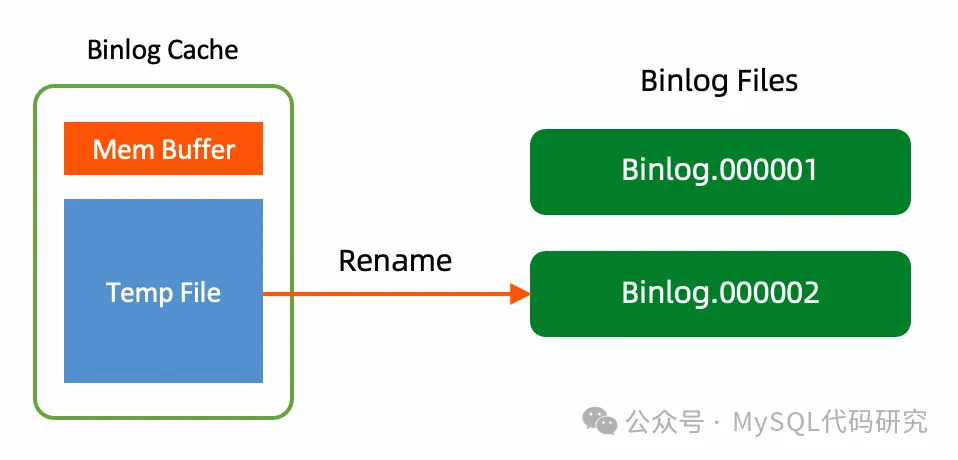
The idea is simple and clean: since the Binlog Cache has already written the binlog events to a file, we just rename that file directly into a binlog file. This avoids copying the binlog events, so there is no extra IO. And a rename takes constant time regardless of the Binlog Cache’s size, which fully solves the large-transaction problem. Let’s look at the implementation.
The #binlog_cache_files Directory
The Binlog Cache’s file is a system temporary file, which can’t be renamed into a regular file directly. So we create a directory, #binlog_cache_files, in the binlog directory; the file the Binlog Cache creates then becomes a regular file in this directory instead of a system temp file.
1
2
$ls var/mysqld.1/data/#binlog_cache_files
ML_140413554102520
Reserving Head Space
The Binlog Cache file contains only the transaction’s binlog events. To turn it into a binlog file, we need to reserve some space for the binlog header events, such as the Format_description_event.
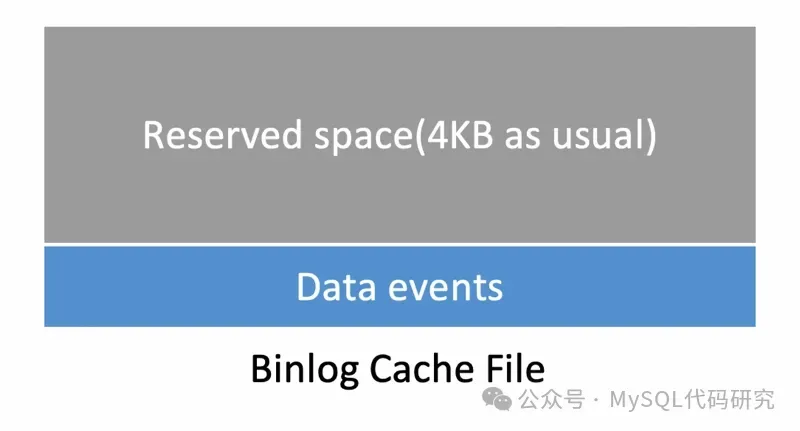
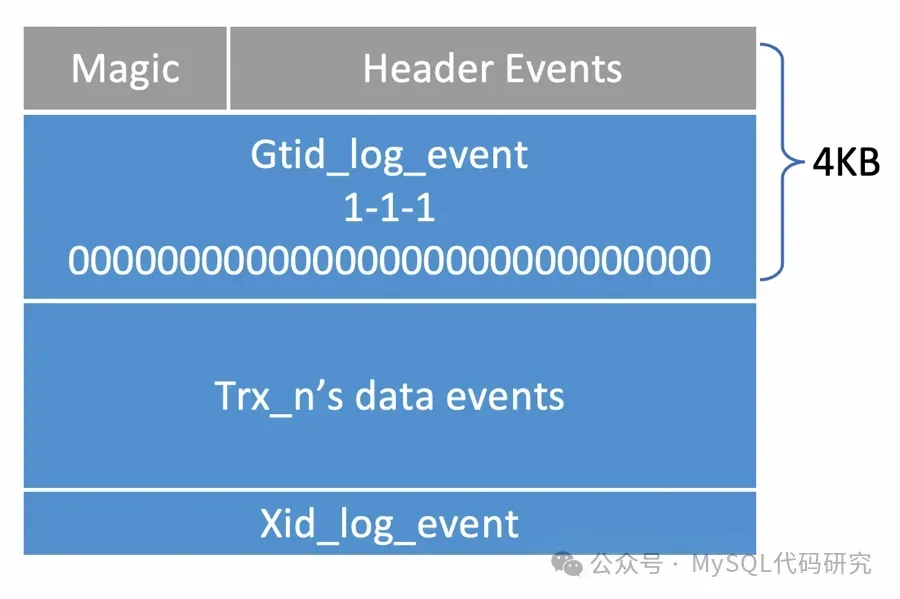
The reserved space is 4 KB-aligned, so at least 4 KB is reserved, which is enough in most cases. But in some situations the Gtid_list_log_event (similar to MySQL’s Previous_gtids_event, recording the GTID set generated before this binlog) can be very large. To keep the feature usable in that case, when generating a new binlog file we adjust the reserved space based on how much the header events actually occupy; the Binlog Cache file’s reserved space is then adjusted when the next transaction begins. The binlog header events usually take less than 4 KB, so after writing them some space may be left over. How do we handle the leftover? Thanks to MariaDB’s mechanism of padding a Gtid_log_event with trailing zeros, the leftover space is absorbed into the corresponding Gtid_log_event. After the Binlog Cache file is turned into a binlog file, its structure looks like this:
The Rename Process
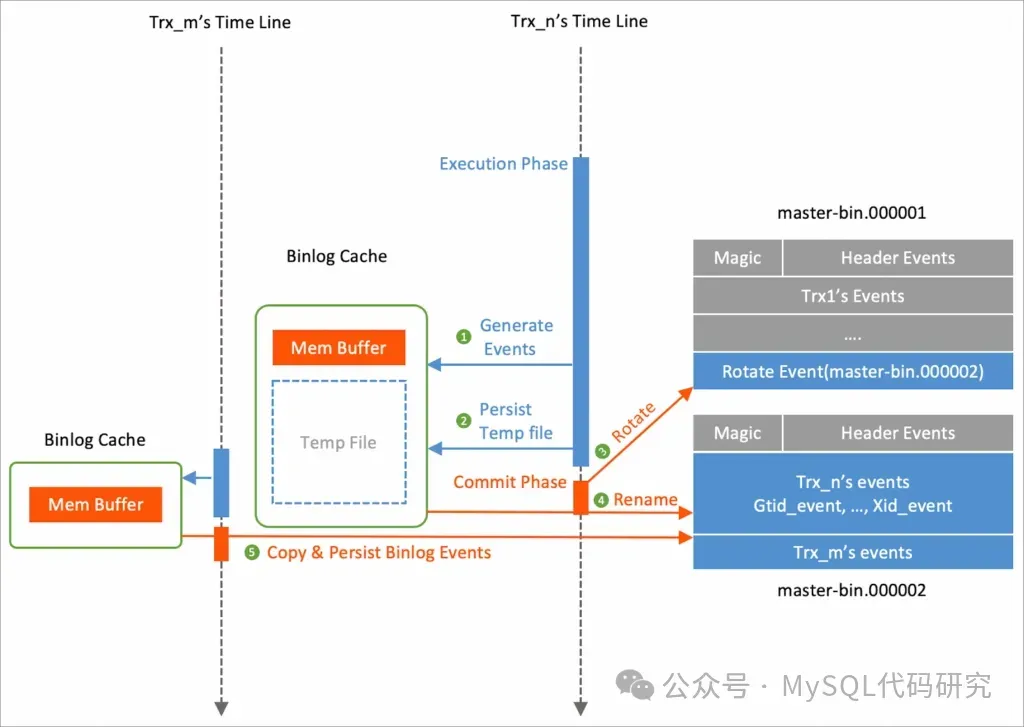
The rename works roughly as follows:
- Persist the Binlog Cache file. At this point the rename hasn’t started, so it doesn’t block other transactions from committing.
- Perform a rotate: close the current binlog file and create a new one.
- Copy the new file’s header into the head of the Binlog Cache.
- Generate the
Gtid_log_event. - Delete the newly generated binlog file, and rename the Binlog Cache file into the new binlog file.
Results
Again we used sysbench to simulate a workload, then ran a large UPDATE in the background every 5 seconds, each producing 512 MB of binlog events. The results:
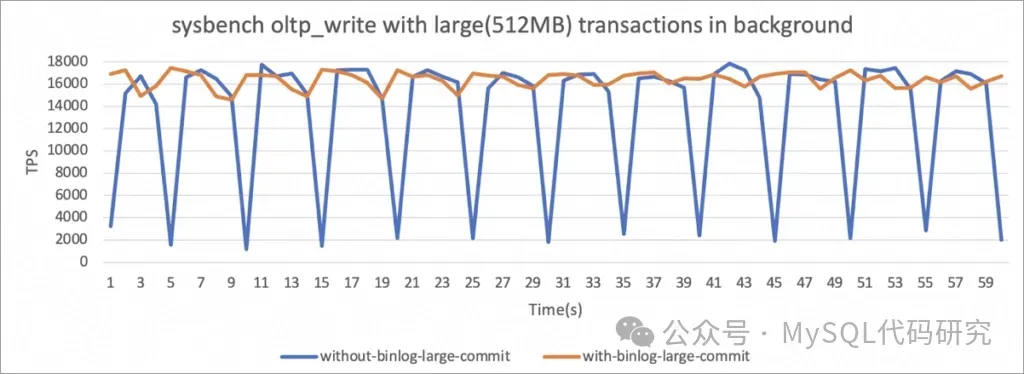
With the large-transaction commit optimization, sysbench’s TPS is fairly steady, with no violent swings. There’s still a small dip every 5 seconds, but that comes from the large UPDATE itself using some CPU, not from transaction commit.
We also simulated the DML latency caused by transactions of different sizes. The results:
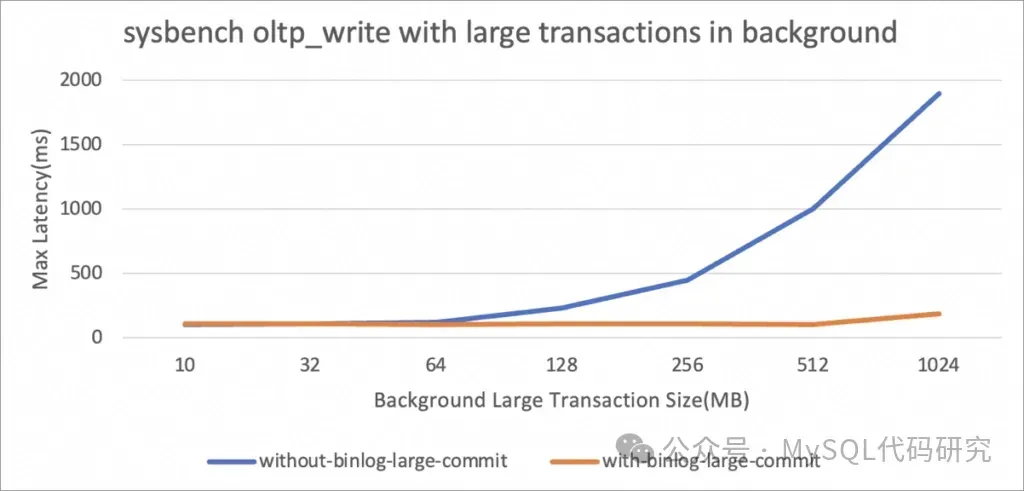
- Without the optimization, once a large transaction exceeds 64 MB, sysbench’s max latency starts to climb noticeably, and rises rapidly as the transaction grows.
- With the optimization on, sysbench’s max latency stays stable no matter how large the transaction, holding at normal workload levels. At 1024 GB, one extra binlog rotate adds a slight bump in latency.
Conclusion
In MySQL’s binlog replication architecture, large transactions are a classic trigger for trouble, causing stability and replication-lag problems. By renaming the Binlog Cache’s temporary file directly into a binlog file, we avoid copying binlog events and eliminate the extra IO, keeping large-transaction commit fast and stable — and fully resolving the various stability problems that large-transaction commit causes.
MariaDB 11.7 — Binlog Commit Optimization for Large Transactions ↩︎